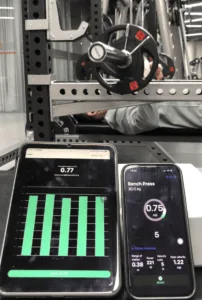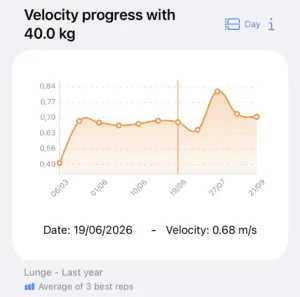
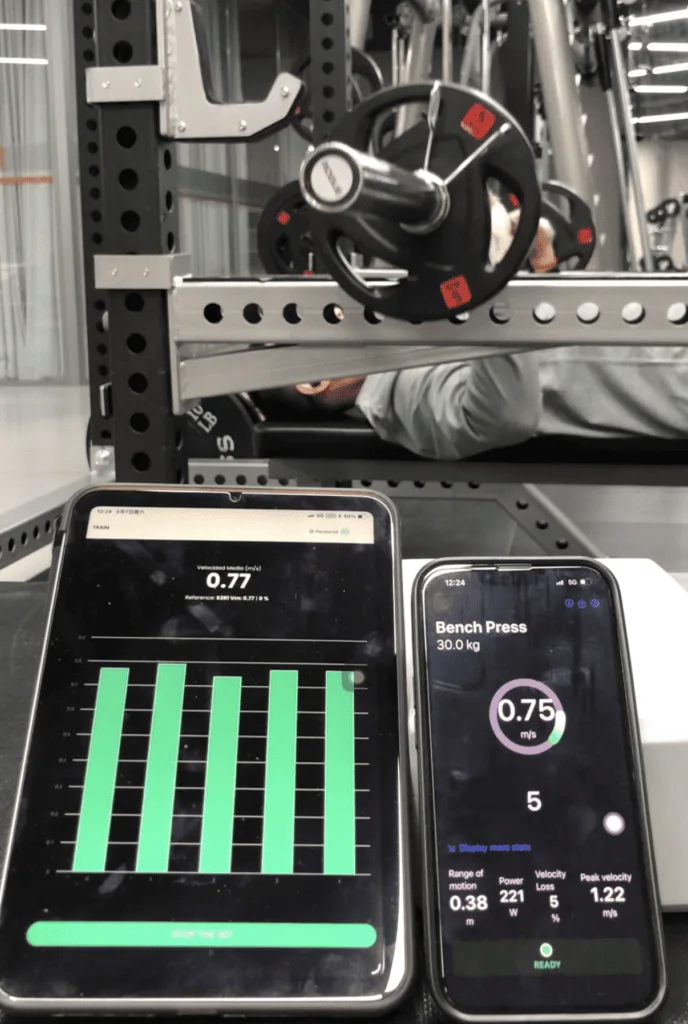
In this article, we discuss the validation study by Li and colleagues and explain why we expect Spleeft to perform better if the test is repeated with our 2026 algorithm and measurement guidelines. We created Spleeft from our experience as coaches to improve the service we provide to athletes. Reliable velocity measurements are central to that commitment: they inform decisions such as adjusting a load or ending a set. How we improve Spleeft’s algorithm with training data.
Metric agreed more closely with GymAware in the 2024 protocol by Li, Tang and Feng. Across 75 bench press repetitions at 50% of 1RM, correlation with GymAware was r = 0.937 for Metric and r = 0.733 for Spleeft. With the Apple Watch on the forearm, Spleeft recorded velocities 0.070 m/s lower on average than GymAware. This result concerns mean concentric velocity, one load and an earlier version of Spleeft. In 2026, we changed how we detect rest and define repetition boundaries. An independent research team is evaluating improvements in the current version. Li, Tang and Feng study · Metric’s article · Spleeft update.
The study’s explanation goes beyond what was measured
Li and colleagues suggest a low sampling rate as a possible explanation for the result. In the equipment section, they describe Spleeft’s sampling rate as typically 100 Hz or higher, without stating which mode was used in the test. The Apple Watch Series 9 had supported the 200 Hz mode since May 2024. Metric recorded at 60 fps, but the camera tracks position whereas the watch measures acceleration. To determine whether sampling rate influenced the result, the 100 and 200 Hz Spleeft modes would need to be compared while controlling the other conditions. Study, sections 2.3 and 4 · 200 Hz announcement from May 2024.
It is also worth clarifying how the app worked. Spleeft calculated vertical velocity on the Apple Watch itself, using acceleration and orientation estimates based on data that included the gyroscope and magnetometer. The study places the calculation on the iPhone or iPad and attributes signal smoothing and mean propulsive velocity to the version tested. The Butterworth low-pass filter we use today and mean propulsive velocity arrived with the 2026 update. Study, section 2.3 · Spleeft technical documentation · 2026 update.
Evidence missing from the comparison
The discussion by Li and colleagues omits a relevant earlier study for interpreting watch performance. In 2023, Achermann and colleagues compared an Apple Watch Series 7 with Vicon motion capture during free-weight squats. For mean velocity, they found correlations of r = 0.952–0.965 at the wrist and r = 0.971–0.979 on the barbell. They used SensorLog to record the data and their own processing. This is independent evidence of what the watch can measure in that exercise with that method. Achermann et al., 2023.
At Spleeft, we have also published comparisons of the app with several references. In 2022, we tested Smith machine squats against a linear transducer. In 2024, we compared Spleeft with Vitruve in squats, STT motion capture in lunges and GymAware in the bench press. In our own bench press comparison, we also observed systematic bias against GymAware despite a high correlation. 2022 Spleeft validation · 2024 Spleeft validations.
What we improved in 2026
Our October 2024 guide already recommended a brief pause to recalibrate velocity to zero. During the bench press, the watch may continue to record small movements while the athlete stabilises the bar. Smart Zero improves the detection of rest and repetition boundaries under those conditions. The current version also allows an iPhone to control a watch attached to the barbell and save the inertial signal so users can review how each reading was calculated. 2024 guide · Algorithm development · Smart Zero.
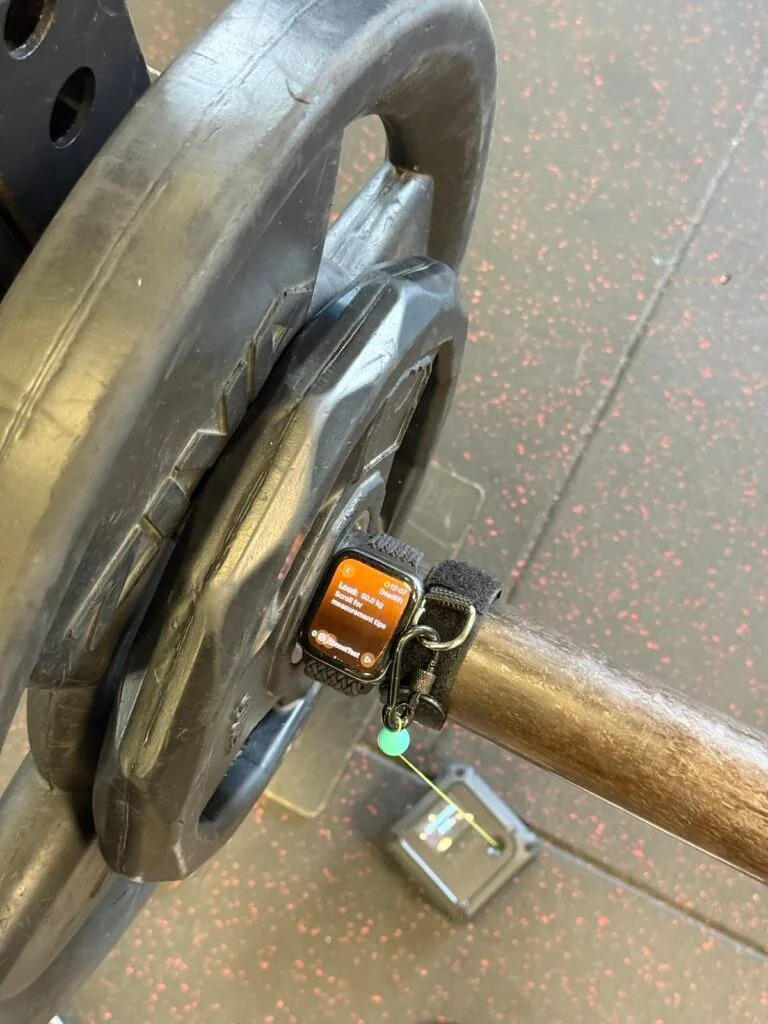
Watch Apple Watch VBT vs GOLD standard on YouTube.
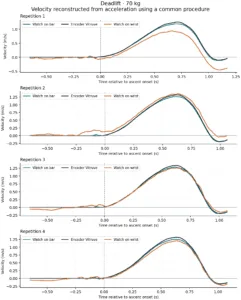
In our exploratory 2026 deadlift tests, the curve reconstructed with the watch on the barbell was closer to Vitruve’s in 14 of 15 repetitions. The watch model and algorithm version also changed in that test, and we used encoder data in the reconstruction. Spleeft’s 2026 field test.
Conclusion
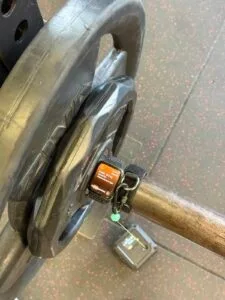
Our published tests and the changes introduced in 2026 give us reason to expect better agreement with GymAware in the bench press than in the 2024 test. Our current guidelines are to attach the Apple Watch to the barbell for exercises such as the bench press and deadlift, and to pause briefly between repetitions so Spleeft can recalibrate the signal. With that setup and Smart Zero, we expect to estimate mean concentric velocity more accurately. Repeating the 2024 comparison with the current version would allow us to quantify any improvement. Spleeft measurement guide · Smart Zero update.
Independent validation of mean propulsive velocity is underway. We already have new ideas for 2027 to continue improving our measurement algorithms.
Ready to track your training? Download Spleeft on the App Store.