Te subes al montículo, respiras hondo y lanzas un golpe. La pistola muestra un número que está... bien. No está mal. Pero no el número que hace que los entrenadores paren su conversación a mitad de frase.
Si estás aquí, probablemente te estés preguntando: “¿Qué entrenamientos de béisbol para lanzadores para aumentar la velocidad funcionan realmente?”.”
Y ya habrás oído los consejos habituales: lanzar más, lanzamientos largos, pelotas lastradas, arreglar la mecánica, hacerse más fuerte. El problema no es que esas ideas sean erróneas. El problema es que la mayoría de los lanzadores las aplican como una receta a la que le faltan medidas: sin termómetro, sin escala, sólo vibraciones.
Ahí es donde el entrenamiento de la velocidad en el béisbol se vuelve mucho más interesante cuando se incorpora el Entrenamiento Basado en la Velocidad (VBT). No “entrenar duro”. No “entrenar explosivo”. Entrena con objetivos de velocidad medibles, fatiga medible (pérdida de velocidad) y un plan claro para progresar la carga semana a semana.⁹
Este artículo es un desglose completo, amigable para el entrenador, del entrenamiento de velocidad de béisbol basado en VBT, y cómo utilizar Spleeft App para hacerlo práctico día a día en el gimnasio.
¡DESCARGA LA APLICACIÓN SPLEEFT AHORA PARA iOS, ANDROID Y APPLE WATCH!
Con qué se construye realmente la “velocidad del béisbol
Lanzar no es un truco de brazo. Es un problema de cadena cinética completa: transferencia de fuerza e impulso desde el suelo, a través de las caderas y el tronco, hacia el brazo que lanza y, finalmente, hacia la pelota. Las revisiones de la mecánica de lanzamiento muestran sistemáticamente que la velocidad de lanzamiento está ligada a factores cinemáticos/cinéticos específicos en todo el cuerpo, no sólo en el hombro o el codo de forma aislada.
Eso importa porque cambia la forma de responder a “Cómo lanzar una pelota de béisbol más rápido”:
No basta con “fortalecer el brazo”.”
Aumentas la producción de fuerza en la parte inferior del cuerpo.⁴
Desarrollas la potencia de rotación y la sincronización a través del tronco.
Entrenas el brazo para tolerar y expresar esa potencia con seguridad.⁵
Y mides los resultados para no entrenar a ciegas.
Un modelo mental útil:
Parte inferior del cuerpo = el motor
Maletero = la transmisión
Brazo = el látigo (y la parte que se rompe si las piezas anteriores son débiles o inoportunas)
Por qué VBT se adapta al béisbol como un guante
Los programas de levantamiento tradicionales suelen prescribir la carga utilizando porcentajes (70% de 1RM, 80% de 1RM, etc.). Esto puede funcionar. Pero los lanzadores no son powerlifters. Su “preparación” cambia mucho en función del volumen de lanzamientos, los viajes, el sueño y el caos general de una temporada.
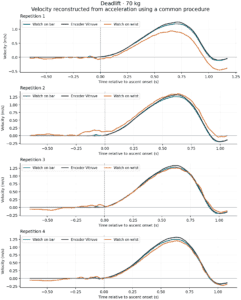
VBT resuelve un gran problema: te da información objetiva sobre cómo estás moviendo la carga hoy. Convierte el “creo que soy explosivo” en “mi velocidad de barra está en la zona que queremos”⁹.
Dos ideas centrales de la VBT son especialmente útiles para los lanzadores:
Perfiles de velocidad de carga
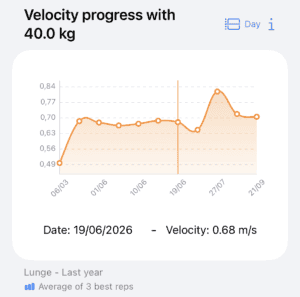
La relación carga-velocidad se utiliza ampliamente en entrenamiento de resistencia para estimar y controlar el rendimiento, ya que, a medida que aumenta la carga, la velocidad de elevación suele disminuir de forma predecible.⁶⁷
En la práctica, esto significa que puedes:
Controla si te estás fortaleciendo sin llegar al máximo constante⁶.
Ver la fatiga temprana (caídas de velocidad en cargas que normalmente se mueven más rápido)⁹
Ajustar las cargas de entrenamiento en función de la realidad, no de una hoja de cálculo⁹.
Umbrales de pérdida de velocidad
La pérdida de velocidad es cuánto se ralentizan las repeticiones en una serie. Es un medidor de fatiga simple y brutalmente honesto. Si tu primera repetición es nítida y la sexta parece atascada en el barro, tu sesión acaba de cambiar, incluso si sigues la misma prescripción “3×6”.
Para los lanzadores, la gestión de la fatiga no es sólo rendimiento: es gestión del riesgo. Cuando la fatiga aumenta, la mecánica puede degradarse, y el brazo tiende a pagar la factura".
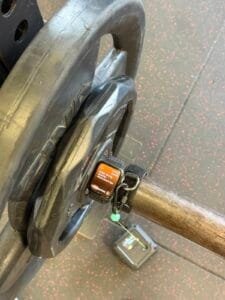
Aquí es donde Spleeft App encaja de forma natural: te permite realizar un seguimiento de la velocidad de repetición, estimar la carga óptima y gestionar la pérdida de velocidad para que tus entrenamientos de béisbol para lanzadores para aumentar la velocidad se mantengan en la zona productiva en lugar de derivar hacia el volumen basura.⁹
Un mapa de zonas de velocidad apto para autocares
En lugar de etiquetar las zonas con la terminología “velocidad-fuerza”, hagámoslo sencillo y relevante para el béisbol: estás entrenando diferentes partes del espectro fuerza-velocidad.⁹
Tabla: zonas prácticas de velocidad para lanzadores (gimnasio)
| Nombre de la zona (en inglés) | Rango típico de velocidad de barra | Objetivo principal | Los mejores ejemplos de ascensores |
|---|---|---|---|
| Fuerza máxima (pesada) | ~0,20-0,40 m/s | Construir una capacidad de fuerza elevada | Sentadilla, peso muerto con barra |
| Fuerza con intención (moderada-pesada) | ~0,40-0,60 m/s | Crea una fuerza que puedas expresar con rapidez | Sentadillas más pesadas, jalones |
| Zona de potencia (moderada) | ~0,60-0,80 m/s | Construir fuerza × velocidad de salida | Sentadillas con salto, tirones de barra más ligeros... |
| Enfoque de aceleración (ligero/moderado) | ~0,80-1,00 m/s | Producción rápida de fuerza | Split squat jumps, saltos cargados (ligeros) |
| Reactivo/balístico (muy ligero) | ~1,00 m/s y más (contextual) | Salida elástica/reactiva e intención | Pliométrica, lanzamientos de balón medicinal |
Nota importante: El “mejor” rango de velocidad exacto depende del ejercicio, del atleta y del dispositivo/aplicación que se utilice para medirlo. El punto es la lógica: haz coincidir la zona con la adaptación que deseas, y no dejes que la fatiga te empuje a una zona diferente por accidente.⁹
Lo que apuntan las pruebas en el entrenamiento de la velocidad en béisbol
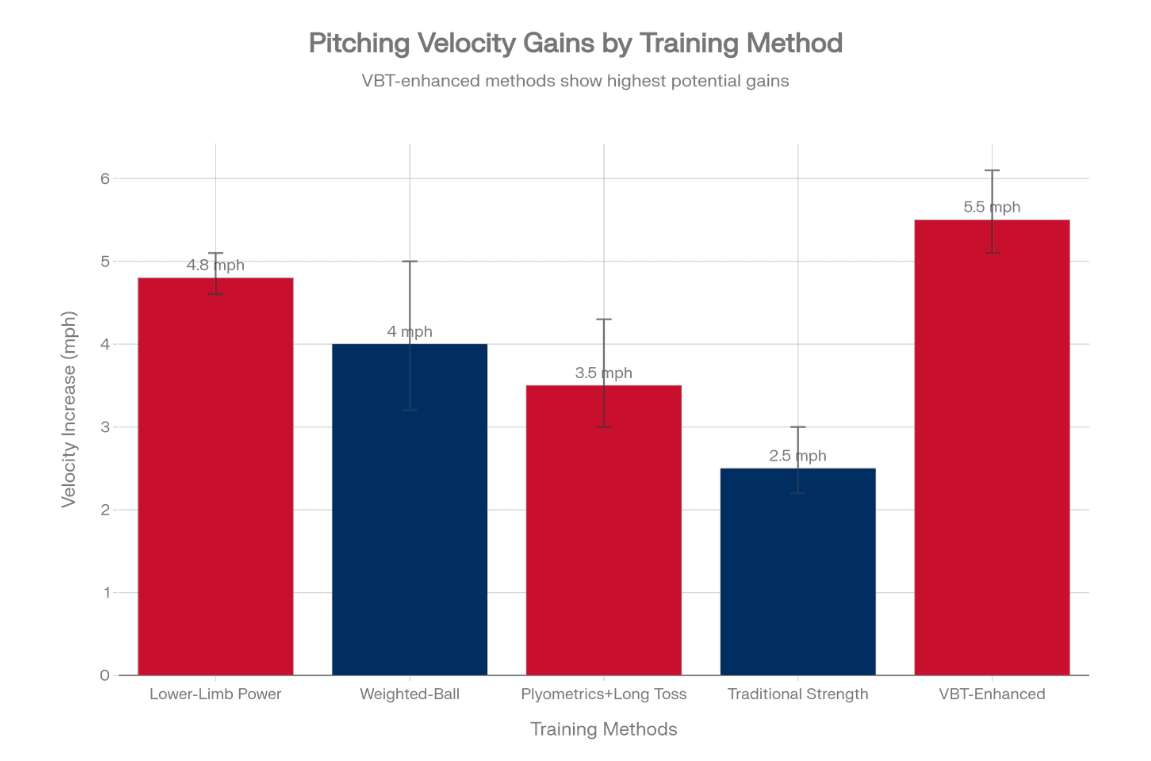
Hablemos de métodos que aparecen una y otra vez en la investigación sobre el rendimiento de los lanzamientos y en la práctica de alto nivel.
El entrenamiento de la parte inferior del cuerpo importa (y mucho)
Los trabajos centrados en la contribución de las extremidades inferiores ponen de relieve que la velocidad de lanzamiento puede mejorarse si se trabaja la fuerza y la potencia de la parte inferior del cuerpo, ya que ésta es uno de los principales motores de la generación de fuerza e impulso.⁴
Traducción: si quieres resultados más rápidos de béisbol en el montículo, es necesario entrenar las piernas y las caderas como si realmente importan-porque lo hacen.⁴
Las pruebas de salto se relacionan con el rendimiento de los lanzamientos
Hay un interés constante en cómo se relacionan los resultados de los saltos con las métricas de lanzamiento, y las revisiones discuten las relaciones entre varias pruebas de salto y el rendimiento de los lanzamientos de béisbol.²
No es necesario que te conviertas en un “atleta del salto”, pero deberías considerar la capacidad de salto como un indicador práctico de la potencia y la preparación de la parte inferior del cuerpo, especialmente durante la temporada, cuando no es buena idea llegar al máximo en los levantamientos.²
Programas de pelota pesada: útiles, pero no casuales
Las revisiones sistemáticas sobre los programas de mejora de la velocidad de lanzamiento de pelotas ponderadas muestran que estos enfoques pueden aumentar la velocidad de lanzamiento, pero conllevan importantes consideraciones de programación y riesgo¹.
Punto aparte: el entrenamiento con pelotas de béisbol más ligeras se ha estudiado como método para aumentar la velocidad de lanzamiento sin que aumente necesariamente el riesgo de lesiones, dependiendo de cómo se aplique.⁵
Conclusión práctica: los balones lastrados no son “malos” ni “buenos”. Son una herramienta con un coste. Si las usas, necesitas estructura, progresión y control de la fatiga, exactamente el tipo de entorno en el que los principios de la VBT son útiles.¹⁹
El acceso al entrenamiento de fuerza influye en las métricas de lanzamiento
Las investigaciones que analizan las limitaciones de los equipos de entrenamiento de resistencia fuera de temporada sugieren que la exposición al entrenamiento de fuerza (o la falta de ella) puede influir en las métricas relacionadas con los lanzamientos en entornos universitarios.⁸
Traducción: el gimnasio no es opcional si quieres progresar en velocidad a largo plazo. Pero no necesitas trabajo aleatorio en el gimnasio, sino trabajo dirigido y medido.⁸
La pila de entrenamiento “cómo lanzar una pelota de béisbol más rápido” (qué priorizar)
Si desea una jerarquía práctica (especialmente para los entrenadores que elaboran un plan), utilice ésta:
1) Calidad y disponibilidad de los desplazamientos
Movilidad de cadera que puede controlar (no concursos de flexibilidad pasiva)
Control de la rotación torácica
Control escapular y capacidad del hombro
Un programa de lanzamientos que no se opone a tu volumen de levantamientos
Todo esto es importante porque la velocidad de lanzamiento está relacionada con la secuencia y la cinemática de todo el cuerpo, no sólo con la fuerza del brazo.
2) Fuerza y potencia de la parte inferior del cuerpo
Sentadillas / split squat
Patrones de bisagra (el levantamiento de peso muerto con barra de tracción suele ser favorable al lanzamiento).
Saltos (poco volumen, mucha intención)
El entrenamiento de las extremidades inferiores puede impulsar mejoras en la velocidad de lanzamiento.⁴
3) Potencia de rotación y sincronización
Lanzamientos de balones medicinales (lanzamiento de cuchara, variaciones de lanzamiento de peso, vapuleos rotativos)
Fuerza antirrotación (es necesario resistir la rotación para crearla)
Estos componentes coinciden con la implicación del tronco señalada en las revisiones cinemáticas de la velocidad de lanzamiento.³
4) Cuidado del brazo y tolerancia
Fuerza y resistencia del manguito de los rotadores
Soporte de rotación escapular hacia arriba
Capacidad de agarre del antebrazo (a menudo ignorada)
Las intervenciones centradas en el brazo y la carga específica del lanzamiento necesitan una programación que tenga en cuenta los riesgos.¹
5) Medición y autorregulación (el multiplicador)
Seguimiento de la velocidad de la barra⁹
Umbrales de pérdida de velocidad⁹
Actualizaciones del perfil de carga-velocidad⁶⁷
Aquí es donde VBT ayuda a mantener el plan honesto e individualizado.⁹
Entrenamientos de béisbol para lanzadores para aumentar la velocidad (estilo Vbt)
A continuación se muestra una estructura semanal que puede ejecutar en la temporada baja (o principios de la pretemporada) con 3-4 días de gimnasio. Está construida intencionadamente para que puedas entrenar “velocidad de béisbol” sin convertir cada sesión en un festival de fatiga.⁹
Resumen semanal (ejemplo)
Día 1: Fuerza tren inferior + tronco
Día 2: Fuerza de la parte superior del cuerpo (apta para lanzadores) + cuidado de los brazos
Día 3: Potencia del tren inferior + potencia rotacional
Día 4 (opcional): Capacidad mixta + movilidad + accesorios de bajo esfuerzo
DÍA 1: FUERZA TREN INFERIOR + TRONCO
A1) Peso muerto con barra de trapecio o variación de sentadilla
4-6 series de 3-5 repeticiones
Utiliza Spleeft App para mantener las repeticiones en un rango de velocidad pesado pero controlado (zona de fuerza máxima)⁹.
Parada fija si la pérdida de velocidad es grande y la técnica se degrada (un práctico quitamiedos)⁹
A2) Sentadilla dividida (pie trasero elevado o estándar)
3-4 series de 6-8 repeticiones
Zona de velocidad moderada, fatiga controlada⁹.
B) Trabajo antirrotación (Pallof press o presas de cable)
3 series, controladas (la función del tronco se alinea con la importancia de la secuencia de todo el cuerpo)³.
C) Finalizador de cuidado del brazo
Trabajo de retracción/depresión escapular
Volumen de rotación externa del manguito de los rotadores (ligero)¹
DÍA 2: FUERZA DE LA PARTE SUPERIOR DEL CUERPO (PARA LOS HOMBROS) + CUIDADO DE LOS BRAZOS
A) Press de banca con mancuernas o press con agarre neutro
3-5 series de 5-8 repeticiones
Seguimiento de la velocidad, si procede; el objetivo es la calidad de las repeticiones, no la molienda⁹.
B) Variación de remo (apoyado en el pecho si es posible)
4 series de 6-10 repeticiones
C) Landmine press (a menudo respetuoso con los hombros)
3 series de 8 repeticiones
D) Bloqueo de cuidado del brazo (corto, consistente)
Rotación externa + trapecio inferior + trabajo del serrato¹
DÍA 3: POTENCIA DEL TREN INFERIOR + POTENCIA ROTACIONAL
A) Sentadilla de salto (carga ligera a moderada)
5-8 series de 2-3 repeticiones
Controla la velocidad con Spleeft y mantenla en tu “zona de potencia”⁹.
Detente pronto si la velocidad disminuye; esto es práctica de potencia, no condicionamiento⁹.
B) Salto pliométrico (box jump o salto de longitud)
4–6 series de 2–3 repeticiones
Descanso prolongado, alta intención (enlaces de salto a relaciones de rendimiento de lanzamiento)²
C) Lanzamientos rotativos con balón medicinal
4-6 series de 3-5 repeticiones por lado
Trátalo como un entrenamiento de “intento de lanzamiento rápido de béisbol”: repeticiones breves, mucho descanso².
DÍA 4 (OPCIONAL): CAPACIDAD + MOVILIDAD + VOLUMEN DE BAJO ESFUERZO
Empujes de trineo, cargas ligeras, circuitos de movilidad
Mantén una fatiga razonable; el objetivo es la durabilidad⁹.
Principio clave del coaching: Para los lanzadores, el entrenamiento de potencia debe parecer aburrido sobre el papel y explosivo en la ejecución. Si la sesión se convierte en un caos sudoroso, tus rendimientos suelen bajar y tu siguiente día de lanzamiento empeora.⁹
Cómo SpleeftApp lo hace más fácil (y seguro)
He aquí el problema cotidiano en el entrenamiento de béisbol: los entrenadores programan “potencia”, pero los atletas caen en la “fatiga”. O los entrenadores programan “fuerza”, pero los atletas mueven la barra como si estuvieran medio dormidos.
Spleeft App te ayuda:
Mide la velocidad de repetición en ejercicios de barra y movimientos seleccionados⁹
Rastrea la pérdida de velocidad para que los conjuntos no se conviertan en trituradoras⁹
Construye y perfecciona tu perfil de carga-velocidad con el tiempo⁶⁷.
Estima la “carga óptima” para el día en función de cómo te muevas⁹.
Mantén un entrenamiento honesto cuando el calendario de la temporada sea caótico⁹
Ejemplos prácticos:
Si tu carga habitual de calentamiento se mueve más lento de lo normal, no estás tan preparado. Ajusta el día.⁹
Si tu pérdida de velocidad alcanza tu umbral antes de tiempo, has acumulado fatiga más rápido de lo esperado. Reduce el volumen.⁹
Si tu velocidad de salto en sentadilla en el día de potencia es inferior a tu línea de base, no “te esfuerces”. Estás practicando repeticiones lentas, no potencia.⁹
Así es como te mantienes en el camino productivo hacia “cómo lanzar una pelota de béisbol más rápido” sin quemar el brazo (o el sistema nervioso) del atleta en el proceso.⁹

Una progresión de 12 semanas de entrenamiento de la velocidad en béisbol
Semanas 1-4: Construir la base (fuerza + exposiciones de potencia limpia)
Cuerpo inferior pesado 1-2x/semana⁴
Potencia tren inferior 1x/semana².
Lanzamientos rotativos 2x/semana (bajo volumen)²
Utilice Spleeft para establecer velocidades de referencia y fijar límites sensibles de pérdida de velocidad⁹.
Semanas 5-8: Cambio hacia la producción de potencia
Reducir ligeramente el volumen pesado⁹.
Aumenta la calidad del trabajo de fuerza (no la cantidad)⁹
Añade variaciones específicas con el balón medicinal².
Si utilizas pelotas lastradas, mantén una progresión conservadora y controla la fatiga¹.
Semanas 9-12: Convertir en salida al montículo
Mantener la fuerza con una dosis efectiva mínima⁸.
Mantener nítido el trabajo de potencia⁹.
Aumentar la especificidad en las sesiones de lanzamiento (dentro de la estructura de su programa de lanzamiento)³.
Utiliza los controles de preparación de Spleeft para evitar acumular mucha fatiga en los días clave de lanzamiento⁹.
Preguntas frecuentes
¿Deben los lanzadores levantar mucho peso durante la temporada, o es mejor levantar poco y “mantenerse frescos”?
Durante la temporada, el levantamiento de pesas debe orientarse hacia el mantenimiento de la fuerza y la potencia con un volumen menor. Las exposiciones intensas pueden seguir siendo útiles, pero el objetivo es la “dosis mínima efectiva”, no perseguir los récords de gimnasio. Utiliza Spleeft para mantener estables las salidas de velocidad y reduce las series cuando la preparación sea baja, en lugar de forzar un volumen planificado.⁸⁹
¿Ayudan los ejercicios en máquina a la velocidad en el béisbol, o los lanzadores sólo necesitan pesas libres?
Las máquinas pueden ayudar a desarrollar la capacidad tisular y la hipertrofia con una menor exigencia de destreza y, a menudo, una menor tensión articular. Los pesos libres tienden a exigir más coordinación y pueden mejorar los patrones de transferencia de fuerza. Un plan inteligente utiliza ambos: los pesos libres para el patrón principal y las máquinas para el volumen y el apoyo articular. Controla la velocidad en los grandes patrones donde más importa.⁶⁹
¿Cómo deben programar los lanzadores las semanas de deload en un plan centrado en la velocidad?
Las bajas pueden ser planificadas (cada 4-6 semanas) o reactivas (cuando baja el rendimiento). Un enfoque limpio: mantener la carga similar pero reducir el volumen en ~30-50%, y mantener los umbrales de pérdida de velocidad más ajustados. Si Spleeft muestra una supresión persistente de la velocidad basal, es una señal clara para reducir la carga o reducir el solapamiento de lanzamiento + levantamiento.⁹
¿Pueden dos días de gimnasio a la semana aumentar la velocidad en el béisbol?
Sí -especialmente para lanzadores jóvenes e intermedios- si esos dos días están enfocados, son progresivos y se maneja bien el volumen de lanzamientos. Dos días de alta calidad (uno centrado en la fuerza y otro en la potencia) suelen superar a cuatro días mediocres en los que la fatiga acaba con la intención. Spleeft le ayuda a mantener esos dos días realmente de alta calidad.⁸⁹
¿Cuál es una batería de pruebas sencilla para seguir el progreso además de las lecturas del radar?
Utilice un pequeño conjunto de pruebas repetibles: una prueba de salto (salto con contramovimiento), una comprobación de la velocidad submáxima de la barra en un levantamiento clave y una prueba de distancia/consistencia de lanzamiento de balón medicinal rotativo. Las pruebas de salto y las relaciones de rendimiento de lanzamiento se discuten comúnmente en la literatura de rendimiento de béisbol.² Emparéjalas con lecturas de radar durante sesiones de lanzamiento consistentes.

Iván de Lucas Rogero
Aplicación de rendimiento físico y CEO de MSC
Dedicado a mejorar el rendimiento atlético y el entrenamiento ciclista, combinando ciencia y tecnología para impulsar resultados.
Referencias
Programas de mejora de la velocidad con pelota lastrada para lanzadores de béisbol: Una Revisión Sistemática. (2019).
La relación entre diversas pruebas de salto y el rendimiento de los lanzadores de béisbol: Una Breve Revisión. (2024).
Parámetros Cinemáticos Predictivos de la Velocidad de Lanzamiento en Lanzadores de Béisbol Juvenil a Profesional: A Qualitative Systematic Review. (2023).
From Ground Up: Aumento de la velocidad de lanzamiento mediante el entrenamiento de los miembros inferiores. (2024).
Entrenar con pelotas de béisbol más ligeras aumenta la velocidad sin incrementar el Riesgo de Lesiones. (2020).
Relaciones carga-velocidad y fuerza máxima prevista. (2022).
Uso de la relación carga-velocidad para la predicción de 1RM. (2010).
Limitación del acceso a equipos de entrenamiento de resistencia fuera de temporada: The Impact on Collegiate Pitching Metrics. (2024).
Métodos para regular y supervisar el entrenamiento de resistencia (incluye los principios del VBT y marcos prácticos de supervisión). (2020).
Reflexión final
Si quieres los resultados más rápidos del béisbol -si de verdad quieres saber cómo lanzar una pelota de béisbol más rápido- no necesitas más aleatoriedad. Necesitas una mejor medición.
El entrenamiento de la velocidad en béisbol funciona mejor cuando:
La fuerza y la potencia de la parte inferior del cuerpo se entrenan de forma inteligente⁴.
La explosividad rotacional se practica con intento².
El volumen de lanzamiento se gestiona, no se adivina¹.
Se controla la fatiga (pérdida de velocidad)⁹.
La selección de la carga se ajusta al día (perfil de carga-velocidad)⁶⁷
Eso es lo que aporta VBT. Y es por eso que el uso de Spleeft App en sus entrenamientos de béisbol para lanzadores para aumentar la velocidad puede ser la diferencia entre “entrenar duro” y “entrenar con dirección”⁹.