If strength is your engine size, VO₂ max is the size of your fuel pump.
You can bolt on all the power you want in the weight room, but if your system can’t deliver and use oxygen at a high rate, your velocity in repeated efforts will hit a ceiling fast. That’s why endurance coaches obsess over VO₂ max and why more and more team sport coaches now schedule a VO₂ Max Test alongside their sprint and jump profiling.
The good news: you don’t need to be a lab rat with a mask on your face every week. You do need to understand what a VO₂ Max Test actually tells you, how to interpret it, and how to turn that number into practical training intensity—with velocity as your day-to-day steering wheel.
That’s exactly where Spleeft Hub and Spleeft App fit in: the lab (or field) gives you the VO₂ max and key thresholds; Spleeft gives you the velocity and power data to train at the right intensities, on the right days, without guessing.
DOWNLOAD SPLEEFT APP NOW FOR iOS, ANDROID AND APPLE WATCH!
What VO₂ max really measures (and what it doesn’t)
VO₂ max is the maximal rate at which your body can take up, transport, and use oxygen during intense exercise. Think of it as the ceiling of your aerobic engine.¹
Physiologically, that ceiling is determined by:
Cardiac output (how much blood your heart can pump per minute)
Oxygen-carrying capacity of the blood
Capillary density and mitochondrial capacity in working muscles
A proper VO₂ Max Test pushes you to the point where, despite increases in work, oxygen uptake plateaus or no longer rises meaningfully. That’s your VO₂ max: the “no more” signal from your oxygen delivery + utilization system.⁴
What VO₂ max does not tell you by itself:
How efficiently you use that oxygen at race pace (running economy)
Where your lactate threshold sits relative to max
How long you can hold a given fraction of VO₂ max (tlim at vVO₂ max)⁸
This is why two athletes with the same VO₂ max can have very different performance capacities. One might sit on a high fraction of VO₂ max for a long time; the other blows up as soon as they leave the comfort of Zone 2.
Common VO₂ Max Test formats (lab and field)
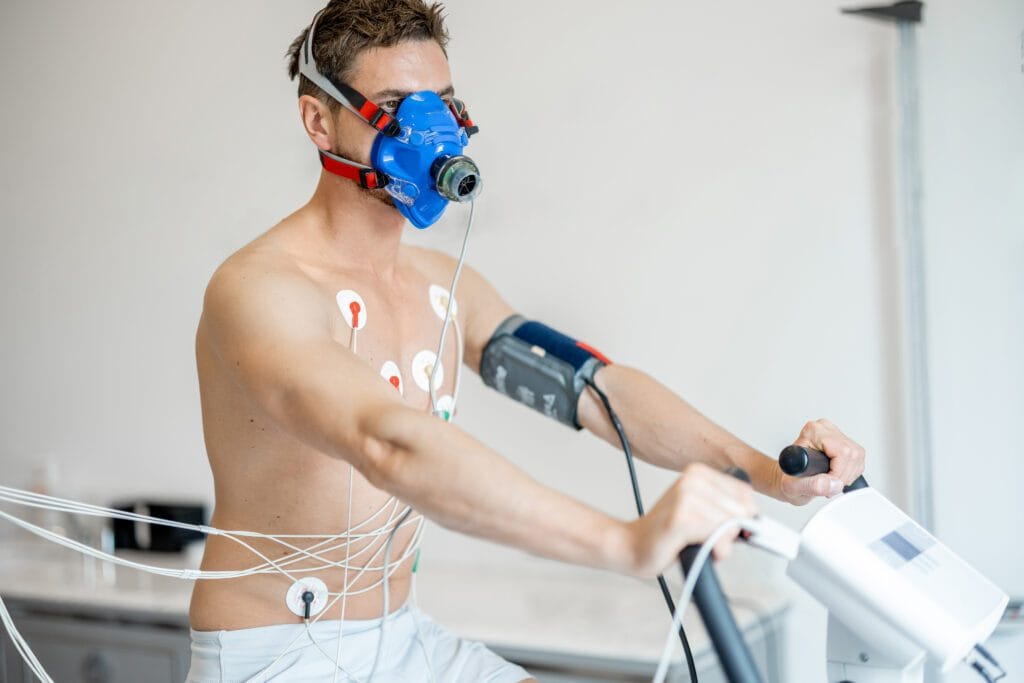
The classic VO₂ Max Test is a graded exercise test (GXT) on a treadmill or cycle ergometer with gas analysis. You start at a low workload and ramp up every minute or few minutes until exhaustion.
Key points from the research:
Treadmill protocols often produce VO₂ max values up to ~6–20% higher than cycle protocols, mainly because running recruits more muscle mass.¹⁴
Well-designed ramp or step protocols that last about 8–17 minutes tend to give the highest, most reliable VO₂ max values.¹⁴
Different incremental protocols (Balke, Bruce, individualized ramps) tend to produce similar VO₂ max values in trained athletes, as long as test duration is appropriate.¹
Verification stages—short extra bouts at or above the last workload—can be used afterward to confirm you truly hit VO₂ max. If the verification bout doesn’t produce a higher value, you can be more confident in your number.⁴
Field-based VO₂ Max Test options behave more like estimates:
20 m shuttle run / beep test (multi-stage shuttle run) often overestimates VO₂ max in some populations.³
12-minute Cooper test, 1200 m shuttle runs, and similar protocols correlate reasonably with VO₂ max but are best treated as performance markers linked to aerobic capacity.⁵
Wearable estimates (smartwatches) are improving but still show meaningful error margins—often underestimating VO₂ max by ~10–15%.⁶ Good for trends, not for clinical decisions.
Why VO₂ Max matters for performance and health
For endurance athletes, VO₂ max sets the upper limit on how much oxygen you can process at high intensity. Runners, cyclists, and rowers with higher VO₂ max have more headroom to sit at a strong pace without redlining instantly.⁷
For team sport athletes, VO₂ max supports:
High-intensity repeatability (back-to-back sprints, repeated transitions)
Faster recovery between explosive efforts
Better tolerance of high-velocity periods in matches
On the health side, higher VO₂ max is strongly and inversely associated with all-cause mortality and cardiovascular risk.⁶ Even for non-athletes, improving VO₂ max is one of the single most powerful levers for long-term health.
But from a coaching perspective, the question is usually not “is VO₂ max important?” It’s “how do I translate a VO₂ Max Test into training I can actually program?” That’s where running velocity, vVO₂ max, and Spleeft come together.
vVO₂ max: the missing link between lab data and actual training
VO₂ max is measured in mL/kg/min. You don’t train in mL/kg/min—you train in pace, velocity, and power.
The minimal running velocity at which you reach VO₂ max is called vVO₂ max.⁸
VO₂ max = ceiling of oxygen use
vVO₂ max = the velocity where that ceiling is reached
For running, a simple field method to estimate vVO₂ max is a 6-minute all-out run and dividing distance by time.⁸ More sophisticated approaches use incremental treadmill tests where VO₂ and running velocity are measured together.
Why vVO₂ max matters for training:
VO₂ max intervals are often prescribed as 90–100% of vVO₂ max
Time spent near vVO₂ max (time at ≥90% VO₂ max) is a key driver of central adaptations
vVO₂ max lets you express aerobic capacity in a language athletes and coaches use daily: velocity
This is precisely where Spleeft Hub and Spleeft App shine: once you know vVO₂ max or a critical velocity linked to your VO₂ Max Test, Spleeft gives you real-time data to hit that intensity precisely in sessions.
How Spleeft Hub connects VO₂ Max Test results to training zones
Think of Spleeft Hub as the bridge between lab numbers and what your athletes do in the gym, on the track, or on the bike.
Workflow might look like this:
Perform a VO₂ Max Test
Lab: treadmill or bike GXT with gas analysis¹⁴
Or: validated field test with an associated protocol (e.g., 1200 m shuttle + prediction equation)⁵
Extract key outputs
VO₂ max (mL/kg/min)
vVO₂ max or maximal aerobic velocity
Thresholds (ventilatory or lactate, if measured)
Load these into Spleeft Hub
Define velocity-based zones around vVO₂ max (e.g., 60–75%, 75–90%, 90–100%)
Link them to specific session types: easy endurance, tempo, VO₂ intervals
Use Spleeft App in sessions
On the track: Spleeft gives real-time velocity feedback each rep
On the bike/erg: use velocity or power targets tied back to VO₂ data
In the gym: combine VO₂-focused conditioning efforts with velocity-based strength work
Now your VO₂ Max Test stops being a PDF in a folder and becomes a living input to daily velocity targets and progression logic.
VO₂ Max interval structures: what actually works
Research and decades of coaching experience converge on a few core structures that reliably improve VO₂ max.⁹¹⁰
Typical VO₂-focused interval prescriptions:
4×4 min at ~90–95% of vVO₂ max with 3–4 min easy between bouts
5–6×3 min at similar intensity with 2–3 min easy recovery
Shorter 30–60 s “on” / equal rest HIIT for some populations, with careful control of total volume
A few key principles:
Time near VO₂ max per session matters more than “heroic” single reps
Recovery must be easy enough to allow high heart rate and velocity in work bouts
Once velocity and HR drop too much, extra reps mostly add fatigue, not adaptation⁹
With Spleeft App, you can anchor these prescriptions in velocity rather than just “feel”:
Target: 4×4 min at 95–100% of your vVO₂ max velocity
Spleeft: shows whether you’re actually holding that velocity across repeats
Coach rule: if velocity drops >5% from the first rep, cut the session there
That turns textbook VO₂ workouts into tightly controlled, individualized sessions.
How Spleeft Hub enhances VO₂ max training in practice
Let’s look at how Spleeft Hub and Spleeft App change the way you run VO₂-focused blocks.
1. Baseline and progression tracking
You test once (lab or high-quality field VO₂ Max Test) and store the values in Spleeft Hub. Over a 6–12 week block, you then track:
Session velocity outputs at VO₂ intensities
Total time spent near target velocity/HR zones
How those outputs change across weeks (e.g., higher velocity for same perceived effort)
When you re-test VO₂ max or vVO₂ max, Spleeft helps you see if the field velocity data truly moved in line with the lab values.
2. Individualizing intensity across athletes
In a team setting, three players might all complete the same VO₂ Max Test, but come back with different vVO₂ max values.
Without tools, you’d either:
Give them all the same paces (too easy for some, too hard for others), or
Spend half the warm-up yelling “you’re too fast” / “you’re too slow” every rep
With Spleeft App:
Each athlete has their own velocity target for VO₂ intervals (e.g., 4.5 m/s, 4.8 m/s, 5.1 m/s)
The app provides immediate feedback when they drift above or below their target band
That’s VO₂ Max Test data driving individualized velocity coaching, rep by rep.
3. Blending VO₂ work with readiness and strength
High-intensity VO₂ blocks are taxing. Combining them blindly with heavy lifting is a fast way to cook athletes.
Readiness and VBT research show that bar velocity and simple neuromuscular markers drop meaningfully under accumulated fatigue.¹¹
Spleeft helps you:
Monitor jump or bar velocity on VO₂ interval days and heavy lifting days
Adjust strength work on days following hard VO₂ sessions (e.g., lighter, higher velocity strength instead of grinding squats)
Flag athletes whose velocity profiles suggest poor recovery from VO₂ training
The result: VO₂ max work that builds velocity capacity instead of eroding it.
Sample 6-week VO₂ Max block using Spleeft Hub
Here’s a coach-ready template you can adapt.
Week 1–2: Build familiarity and anchors
1 VO₂ Max Test or high-quality field test (or use recent lab data)
1 VO₂ interval session/week
1 threshold or tempo session/week
2–3 easy endurance sessions
VO₂ session example:
4×3 min at 90–95% vVO₂ max velocity, 3 min easy jog
Spleeft: track average velocity every rep and total time in target band
Week 3–4: Increase total VO₂ time
1–2 VO₂ interval sessions/week (depending on level)
1 threshold session
Main VO₂ session:
4×4 min at 90–95% vVO₂ max
Spleeft rule: stop if velocity drops >5% from rep 1
Secondary VO₂-flavored session (for advanced athletes):
8–10×60 s at 100–105% vVO₂ max velocity, 60–90 s easy jog
Week 5–6: Consolidate, don’t annihilate
Maintain similar VO₂ volume
Start reducing non-essential intensity
Retest either vVO₂ max or the original field test in week 6
Throughout the block, Spleeft Hub stores:
Session-by-session velocity data at VO₂ intensities
Longitudinal trends for each athlete
Flags for days where VO₂ intervals clearly underperformed (readiness or overload issues)
When you compare the new VO₂ Max Test or vVO₂ max to week 1, you’re not just looking at one number—you’re looking at an entire story of how the athlete’s velocity outputs evolved.
FAQs
1. How often should I repeat a VO₂ Max Test?
For most athletes, every 8–12 weeks is plenty. VO₂ max doesn’t change dramatically week to week. In between, you can use field velocity markers (like a set VO₂ interval session) tracked with Spleeft to gauge progress without re-masking someone on a treadmill.
2. Do I need a lab VO₂ Max Test to use Spleeft Hub effectively?
No. A lab VO₂ Max Test is the gold standard, but you can start with a validated field test (1200 m shuttle, 6-minute run, time trial) and derive vVO₂ max or a MAS (maximal aerobic velocity) estimate. Spleeft cares about velocity and repeatability; as long as your protocol is consistent, the system will still help you train better.
3. Can VO₂-focused work hurt strength and power if I overdo it?
Yes. Too much high-intensity aerobic work can interfere with strength and hypertrophy adaptations, especially if poorly timed. This is why combining VO₂ blocks with velocity-based strength via Spleeft is so useful: you can see when bar velocity on lifts is suffering and adjust volumes and scheduling so VO₂ training supplements, rather than sabotages, power.
4. Is VO₂ Max the best predictor of performance in all sports?
Not by itself. VO₂ max matters a lot for endurance sports, but in many events, factors like economy, threshold, sprint velocity, and tactical ability matter as much or more. Still, having a solid VO₂ Max Test baseline and training around it with Spleeft gives you a robust aerobic foundation to layer those other qualities on top of.
5. How can Spleeft App help individual runners training on their own?
Even solo athletes can use Spleeft to:
Run VO₂ intervals at precise velocity targets based on their VO₂ Max Test
See when their usual VO₂ session velocity is trending up (getting fitter)
Avoid turning recovery days into pseudo-VO₂ days by accidentally drifting into high velocity zones
It’s like having a coach on your wrist constantly asking: “Is this effort actually where we said we’d train today?”

Iván de Lucas Rogero
MSC Physical Performance & CEO SpleeftApp
Dedicated to improving athletic performance and cycling training, combining science and technology to drive results.
References
Poole DC, Jones AM. “Graded Exercise Testing Protocols for the Determination of VO₂max.” Sports Med. 2017.
Whipp BJ. “Optimizing the exercise protocol for cardiopulmonary assessment.” J Appl Physiol. 1983.
Validity work on 20 m shuttle run (MSSRT) vs lab VO₂ Max Test; tendency to over-predict VO₂ max in some samples.
Midgley AW et al. “The Maximal Oxygen Uptake Verification Phase” and follow-up work on verification stages.
Field relationships between VO₂ max, vVO₂ max, and shuttle tests in football players.
Validation of smartwatch-derived VO₂ max estimates vs indirect calorimetry; systematic underestimation and error margins.
Studies comparing VO₂ max between athletes and non-athletes on treadmill and cycle ergometer protocols.
Billat V. Work on vVO₂ max, time to exhaustion at vVO₂ max, and their role in training prescription.
Interval and HIIT literature linking 3–5 min bouts and short HIIT to VO₂ max improvements.
Coaching resources on VO₂-focused interval design, MAS/vVO₂ max usage, and practical programming.