RPE 力量举重与基于速度的训练:哪种方法更有效?

基于 RPE 的力量提升训练与基于速度的训练的对比

You unrack a heavy squat that 应该 be routine. On paper it’s 85%—nothing heroic—but today it feels like a house. You grind out three ugly reps, stare at the bar, and think: “If this was supposed to be @7, why did it feel like @9?”

That gap between the plan and reality is exactly why autoregulation exists. In powerlifting, the two big tools for this are RPE 和 基于速度的训练(VBT). One lives in your head—your perception of effort. The other lives in your bar velocity—objective data on how fast the load is moving.

This article digs into what is RPE, how RPE powerlifting actually works, what VBT brings to the table, and where each method shines (and fails). The goal is not blind hype for one side, but to show how to use both intelligently—and how an app like Spleeft 应用程序 can make the velocity side as easy and practical as checking your messages between sets.

立即下载适用于 iOS、Android 和 Apple Watch 的 SPLEEFT 应用程序!

What Is RPE, Really? (Beyond “How Hard Did It Feel?”)

If you search what is RPE, you’ll get lots of definitions, but in powerlifting the concept is pretty specific:

RPE (Rating of Perceived Exertion) is a 1–10 scale that tells you how close you were to failure on a set. In practice, lifters usually use it as a “reps in reserve” (RIR) scale:

  • RPE 10 = all-out, no reps left

  • RPE 9 = maybe 1 rep left

  • RPE 8 = 2 reps left

  • RPE 7 = 3 reps left

So when a program says “3×5 @ RPE 8,” it’s telling you: choose a load where you could have done about 7 reps, but stop at 5. That’s your lifting RPE in action.

在 RPE powerlifting programs, the entire week might be built around this language:

  • Squat: single @8, then 3×5 @7

  • Bench: 4×6 @8

  • Deadlift: 3×3 @8

The percentages are not fixed in advance. Instead, you pick the weight based on how today’s bar feels and moves.

Why coaches like RPE

There’s solid science behind this approach. RPE:

  • Correlates strongly with physiological markers like 心率, lactate, and percentage of 1RM across a wide range of training contexts¹²

  • Tracks fatigue and internal load reasonably well, even when external load (the weight on the bar) stays constant¹²

  • Has been shown, in meta-analyses, to work as well as fixed percentage-based loading for strength when total work is matched³⁴

In other words, lifting RPE is subjective, but it is not random. When used correctly, it’s a powerful way to autoregulate heavy training.

基于 RPE 的力量提升训练与基于速度的训练的对比

The Dark Side of RPE in Powerlifting

If RPE is so great, why are we even talking about VBT? Because “how hard it felt” is not always an accurate reflection of muscular performance.

The main limitations of RPE

  1. Learning curve
    Beginners and even many intermediates are simply bad at estimating how many reps they had left. They might call a set RPE 9 while actually having 3–4 reps in reserve, or the opposite.⁵

  2. Psychology leaks into the numbers
    Poor sleep, stress, anxiety, and fear of the weight all push RPE higher, even if velocity (and thus performance) is fine. You can feel wrecked but still move the bar well.

  3. No direct link to velocity or bar path
    RPE doesn’t tell you if your technique is decaying or if your bar velocity is dropping more than it should. It’s a coarse tool—useful, but not precise.

  4. Hard to standardize across athletes
    Your RPE 8 might look like my RPE 9. For team settings or remote coaching, that lack of standardization can make programming messy.

So RPE is very useful, but also noisy. That’s where velocity-based training comes in.

What Is Velocity-Based Training (VBT)?

基于速度的训练 uses devices (or apps) to measure how fast the bar moves during each rep. Rather than prescribing only percentage-based loads or only lifting RPE, VBT lets you prescribe:

  • target velocity zone for a lift (e.g., 0.30–0.40 m/s for heavy squat work)

  • velocity loss threshold within the set (e.g., stop the set when bar velocity has dropped 20%)

When you track bar velocity across loads, you can build a 载荷-速度曲线—essentially a personalized graph that shows how your velocity drops as the weight gets heavier. This profile is remarkably linear in the main lifts and can be used to estimate 1RM accurately without maxing out⁶⁷.

Systematic reviews show:

  • Load–velocity relationships can predict 1RM with good validity when properly set up⁶⁷⁸

  • VBT programs produce similar or better strength gains than percentage-based programs, often with lower total volume and lower RPE⁹¹⁰

  • Velocity loss thresholds (e.g., stop a set when velocity has dropped 20% vs 40%) meaningfully influence whether you bias strength or hypertrophy¹¹

In short: VBT gives you objective data on performance, not just how it felt.

RPE vs VBT: How Do They Actually Compare?

Let’s line them up side by side in a powerlifting context.

方面RPE (Lifting RPE)基于速度的训练 (VBT)
Core question answered“How hard did that set feel?” (what is RPE in simple terms)“How fast did I move this load?”
Data typeSubjective (internal load)Objective (external performance)
EquipmentNoneVelocity tracker or app (e.g., Spleeft App)
Learning curveRequires practice and honest self-evaluationRequires initial setup and understanding of velocity zones
Best forSingles, heavy sets, autoregulating intensity on the flyMonitoring fatigue, setting velocity loss thresholds, estimating 1RM, tracking readiness
Main weaknessInfluenced by mood, nerves, pain, egoInfluenced by technical errors and device accuracy; can be misused without context
Evidence vs fixed loadingSimilar strength/hypertrophy when volume is matched³⁴Similar or better strength with less work and lower RPE⁹¹⁰

The key is that both RPE and VBT are autoregulation tools. Meta-analyses comparing subjective (RPE, RIR) and objective (VBT) autoregulation against fixed percentages generally show no clear winner for raw strength when total volume and intensity are equated³⁴⁶. Instead, they offer different lenses:

  • RPE tells you how the session feels

  • Velocity tells you how your body is actually performing

基于 RPE 的力量提升训练与基于速度的训练的对比

Where RPE Powerlifting Shines

RPE is baked into a lot of modern strength training programs for powerlifting for good reasons:

  1. Meet peaking and heavy singles
    That “single @8” before back-off work is almost a rite of passage in RPE powerlifting. It lets you take what’s there on the day without forcing a scripted number.

  2. Accessories and high-rep work
    You’re not going to strap a velocity device to every cable curl. Here, lifting RPE is perfect to keep effort honest without obsessing over numbers.

  3. Low-tech environments
    If you coach in a basic gym, traveling, or with minimal tools, RPE lets you autoregulate load anywhere.

  4. Building athlete self-awareness
    Learning what is RPE in your own body—what RPE 7 actually feels like on squats vs bench—is a skill that carries over into meet attempts, injury management, and long-term sustainability.

But when the goal is precision—especially on the big three—RPE alone starts to show cracks.

Where Velocity-Based Training Wins

The literature on VBT has exploded in the last decade, and several consistent advantages show up for strength athletes:

1. Objective readiness tracking

If your “single @8” moves at the same velocity as last block’s “single @9”, you know your actual performance has improved—even if your perception hasn’t caught up yet.

Conversely, if your supposed @7 is crawling at your usual @9 velocity, something’s off. That might mean poor recovery, illness, or too much accumulated fatigue.¹⁰

2. Smarter set termination (velocity loss)

Meta-analytic data show that:

  • Velocity loss thresholds ≤20–25% within a set tend to favor 力量, keeping fatigue lower¹¹

  • Higher velocity loss thresholds (>25–30%) tend to favor 肥大, thanks to more volume and fatigue¹¹

Instead of just “3×5 @ RPE 8,” you can use “3×5, stop each set when velocity drops 20%.” That’s a very different, very precise way to control fatigue and adaptation.

3. Efficient strength gains with less work

Short-term studies comparing VBT and traditional percentage-based training show:

  • Similar 1RM gains

  • Lower total tonnage and training time in VBT groups

  • Often lower average RPE during sessions⁹¹⁰

In practice: same strength, less wear and tear.

4. Accurate 1RM prediction without testing

Load–velocity profiling allows you to estimate current maxes from a few submaximal sets, avoiding constant heavy attempts. Systematic reviews confirm that, when properly executed, predicted 1RMs from velocity are reasonably close to real maxes⁶⁷⁸.

For powerlifters, that’s gold: you can monitor progress weekly without touching true max singles outside of planned test/meet days.

Using Spleeft App: Making VBT Practical for Powerlifters

The main historic barrier to VBT in powerlifting has been hardware: linear transducers and camera systems were expensive and gym-unfriendly.

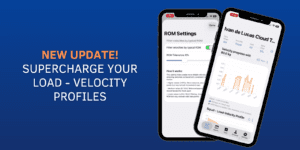
Spleeft 应用程序 changes that by turning the accelerometers in your phone or Apple Watch into a 速度跟踪器:

  • Measures bar velocity rep by rep during squats, bench, deadlifts, and machine work

  • Builds your 载荷-速度曲线 automatically over time

  • Lets you define velocity zones (e.g., heavy strength work at 0.25–0.40 m/s, lighter power work at 0.60–0.80 m/s)

  • 套 velocity loss thresholds per exercise and session goal (e.g., ≤20% for strength, 30–40% for hypertrophy work)

  • Flags days when your baseline velocity is significantly below normal—automatic readiness red flag

In other words, Spleeft brings the lab to the rack, without needing a dedicated VBT device.

RPE vs VBT on a Real Powerlifting Day (With Spleeft)

Let’s look at how a hybrid day might run for a competition-style squat session.

Example: Squat Day – Heavy Strength Focus

Goal: Heavy single + volume work, low fatigue, track progress

  1. Warm-up sets

    • Use Spleeft to check that warm-up sets at familiar loads are moving at or above your usual velocity. If warm-up bar velocity is 10–15% lower than normal, you know you’re not fully ready or you’re carrying fatigue.

  2. Top single

    • Prescription: 1×1 @ RPE 8

    • With Spleeft: Aim for your known “RPE 8 velocity” (e.g., 0.28–0.30 m/s from previous blocks). If today’s 210 kg moves at your usual 0.30 m/s, you’re on target even if it felt a bit heavy.

  3. Back-off sets

    • Traditional RPE-only: 3×5 @ RPE 7

    • Hybrid with VBT via Spleeft:

      • Load: 80% of today’s estimated 1RM from velocity profile

      • Set rule: perform reps until velocity drops 20–25%, then stop the set (maybe that’s 4 reps today, 6 another day)

      • Session rule: if first-rep velocity on sets 2–3 drops >10% from set 1, cut a set to manage fatigue

Here you’re using lifting RPE to set intent and broad zone (“this should feel like a solid but not crushing session”) and 速度 to control the details: how many reps, how many sets, and how close to the edge you really go.

基于 RPE 的力量提升训练与基于速度的训练的对比

So… RPE or VBT? Which Should Powerlifters Trust More?

The honest answer: neither is universally “better.” They answer different questions.

  • 使用 RPE powerlifting methods to:

    • Teach lifters to feel and rate effort

    • Autoregulate when no tech is available

    • Control accessories and high-rep work

    • Guide comp attempts based on bar feeling, nerves, and “todayness”

  • 使用 基于速度的训练 to:

    • Quantify performance objectively

    • Set and enforce velocity loss thresholds for targeted outcomes

    • Build and update load–velocity profiles for accurate 1RM estimates

    • Track readiness across weeks with minimal guesswork

For lifters serious about progressing year after year, the best answer usually isn’t RPE vs VBT, but RPE + VBT, with tools like Spleeft 应用程序 doing the heavy lifting on the data side.

You bring the effort and awareness. The app brings the numbers and structure.

常见问题

1. Can I use RPE and VBT in hypertrophy-focused blocks, or are they only for max strength?

Absolutely. In higher-rep phases, RPE can govern how close you get to muscular failure (e.g., sets of 8–12 at RPE 7–9), and velocity loss from Spleeft can ensure you’re accumulating enough fatigue for growth (e.g., 30–40% velocity loss per set) without turning every set into a sloppy grind. This combination is especially useful for managing high volumes in squats and presses without wrecking recovery.

2. Is VBT useful for deadlifts, where velocity is always low?

Yes, but expectations must be different. Deadlifts naturally move at lower velocities, and joint angles amplify small technique shifts. VBT is still valuable for tracking day-to-day readiness (e.g., your usual 0.20 m/s at 85% dropping to 0.16 m/s signals fatigue) and enforcing conservative velocity loss thresholds (often ≤15–20%) so sets don’t dissolve into ugly, high-fatigue grinders.

3. How should I handle days when my RPE and velocity data don’t match?

Treat mismatches as information, not failure. If RPE is high but velocity is fine, psychological or external factors (stress, poor sleep) may be elevating perceived difficulty, and you can probably still complete planned work. If both RPE and velocity are poor, that’s a clear sign to back off. If RPE is low but velocity is unusually slow, review technique—changes in bar path or depth can disturb velocity readings.

4. Is VBT overkill for beginners who are still learning technique?

For true novices, RPE and VBT both play a secondary role to movement quality and basic consistency. That said, Spleeft can still be useful for building good habits early—showing beginners, for example, how much their second and third reps slow down when they lose tightness. Think of it as education, not strict programming, in the first 6–12 months.

5. How can remote coaches use RPE and Spleeft together with clients?

Remote coaching is where the combo really shines. Clients can send:

  • RPE ratings for every top set (context, how it felt, confidence)

  • Velocity data from Spleeft (actual performance, velocity loss, estimated 1RM trends)

Coaches then adjust block planning, set numbers, and deload timing based on both the story (RPE) and the data (velocity), rather than relying on one or the other. Over time you can build individual velocity–RPE maps for each athlete, dramatically improving online program precision.

伊万-德卢卡斯-罗热罗

伊万·德·卢卡斯·罗杰罗

MSC 身体表现 & SpleeftApp 首席执行官

致力于提高运动表现和骑行训练,结合科学技术来推动成果。

参考

  1. Eston R, Lambrick D, Sheppard K, Parfitt G. Prediction of maximal oxygen uptake from a perceptually regulated sub-maximal graded exercise test. J Sports Sci. 2008;26(2):152–160.

  2. Lagally KM, Robertson RJ. Construct validity of the OMNI resistance exercise scale. J Strength Cond Res. 2006;20(2):252–256.

  3. Grgic J, et al. The Effect of Load and Volume Autoregulation on Muscular Strength and Hypertrophy: A Systematic Review and Meta-Analysis. Sports Med. 2022;52(8):1843–1860.

  4. Zhang M, et al. The effects of velocity-based versus percentage-based resistance training on strength and power in trained individuals. J Strength Cond Res. 2023;37(1):78–89.

  5. Helms ER, et al. RPE-based training for powerlifters: A review and practical recommendations. Strength Cond J. 2018;40(5):34–46.

  6. Marston KJ, et al. Load–velocity relationships and predicted maximal strength: A systematic review of the validity and reliability of current methods. PLoS One. 2022;17(10):e0267937.

  7. Jidovtseff B, et al. Using the load–velocity relationship for 1RM prediction. J Strength Cond Res. 2011;25(1):267–270.

  8. Sayers MGL, et al. The impact of test loads on the accuracy of 1RM prediction using the load–velocity relationship. BMC Sports Sci Med Rehabil. 2018;10:9.

  9. Pelka EZ, Claytor R. Comparison of velocity-based and traditional resistance training on strength, total load, time, and RPE. ISBS Proceedings Archive. 2019;37(1):Article 96.

  10. Weakley J、Mann B、Banyard H 等人。. 基于速度的训练:从理论到应用。. Strength Cond J. 2021;43(2):31–49。.

  11. Grgic J, Schoenfeld BJ, et al. Effect of load and volume autoregulation with different velocity loss thresholds on strength and hypertrophy. Sports Med. 2022;52(8):1843–1860.

分享此帖:

发表评论

您的电子邮箱地址不会被公开。 必填项已用 * 标注

您也可能感兴趣

每次训练你到底需要多少组?-1
一般的

每次训练你到底需要做多少组?

你可能也经历过这种情况。你在训练间隙刷手机,看到有人发帖说他们做了25组胸肌训练。

zh_CN