
增肌最佳训练计划:完整的每周力量训练方案

健身计划

You already know the basics: lift heavy things, eat protein, sleep well. But knowing what to do and actually doing it with the right system in place are two completely different things. Most people jump into a random workout plan and hope it works. Others bounce between routines every three weeks because they’re not seeing the results they expected. The frustration is real—you’re in the gym consistently, you’re trying hard, but something feels off about your approach.

Here’s the truth: Having the right 力量训练计划 isn’t just about exercise selection. It’s about structure. It’s about knowing exactly which muscle groups you’re training each day, how much volume you’re hitting them with, and whether your rep velocity is actually in the hypertrophy zone. A good best workout routine gives you clarity. And when you combine that clarity with objective measurement, results follow.

Let’s break down what a complete strength exercise program 为了 muscle gain actually looks like—week by week, day by day—and how to measure your progress so you’re not just hoping you’re improving.

立即下载适用于 iOS、Android 和 Apple Watch 的 SPLEEFT 应用程序!

The Science Behind Gaining Muscle: Understanding Your Body’s Adaptation

Before we talk about specific exercises, understand this: 肌肉生长 (hypertrophy) isn’t magic. It’s the direct result of three factors: mechanical tension, metabolic stress, and muscle damage. When you train properly, you’re creating a stimulus that forces your muscles to adapt by growing larger.¹

The challenge is that most best workout routines address only one or two of these factors clearly. A workout plan that’s scattered or unfocused delivers weak signals. But a well-structured best workout routine strategically targets all three across the week.²

The research is clear: To maximize muscle growth, you need:

  • 渐进式超负荷: Gradually increasing demands on your muscles over time³

  • Adequate volume: Roughly 10-20 sets per muscle group per week⁴

  • Proper frequency: Training each muscle group 2-3 times per week⁵

  • Controlled rep ranges: Typically 6-12 reps per set for hypertrophy⁶

  • Consistent velocity: Moving with intent to maintain rep quality across sets

This last point is often overlooked but critical: the velocity at which you perform reps directly impacts your training stimulus. Research shows that maintaining a velocity loss of around 30-40% per set—moving from explosive early reps to more controlled later reps—produces optimal hypertrophy stimulus.⁷ This is where most athletes miss the mark. They grind out extra reps beyond where the intended stimulus lies, accumulating fatigue without proportional hypertrophy benefit.

Choosing Your Workout Split: Which Strength Training Program Structure Is Right?

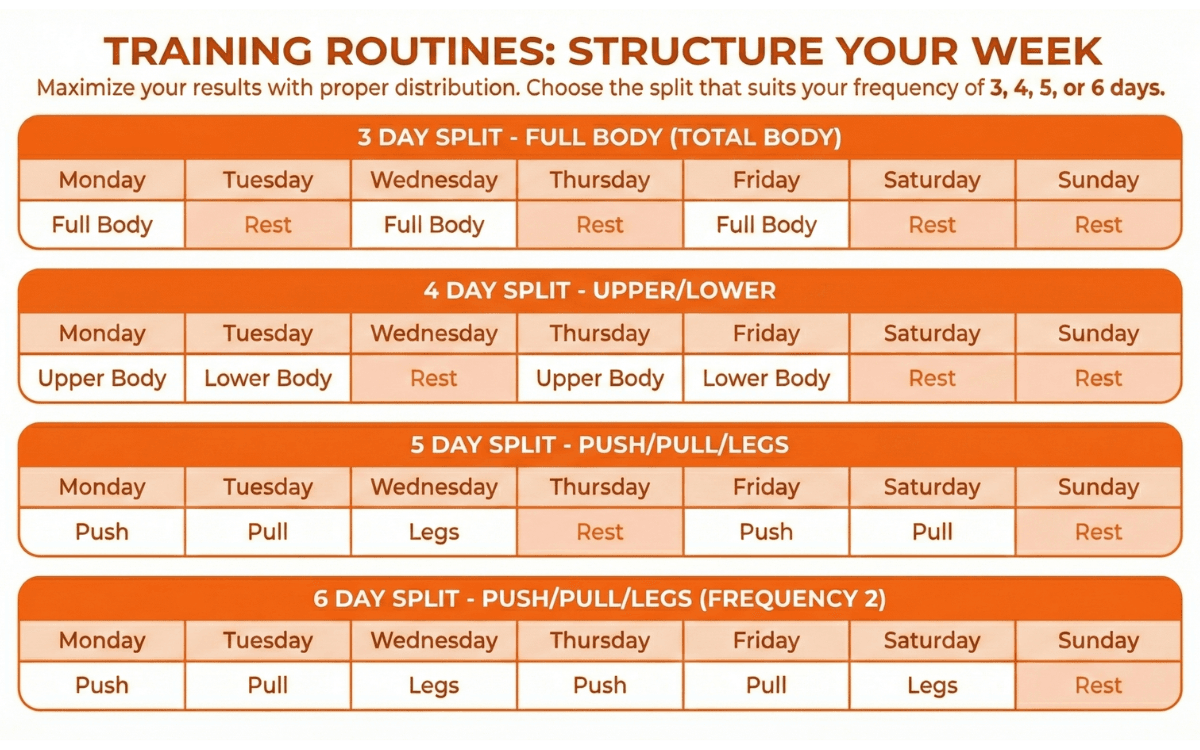
Before designing your specific 力量训练计划, you need to decide how to distribute your training across the week. Research shows several approaches work; the “best” is the one you’ll actually follow consistently.⁸

Full-Body Split (3 Days Per Week)

周一Tuesday周三Thursday星期五SaturdaySunday
Full BodyRestFull BodyRestFull BodyRestRest

优势:

  • Highest frequency per muscle group (3x weekly)

  • Excellent for beginners and recovery-limited athletes

  • Efficient for time-constrained lifters

  • Better motor learning through high-frequency practice

Disadvantages:

  • High fatigue per session

  • Less opportunity for isolation work

  • May not suit advanced athletes seeking high volume

Best for: Beginners, busy schedules, returning to training

Upper-Lower Split (4 Days Per Week)

周一Tuesday周三Thursday星期五SaturdaySunday
UpperLowerRestUpperLowerRestRest

优势:

  • Balanced frequency (2x per muscle group weekly)

  • Moderate session duration

  • Allows compound and isolation work

  • Research-backed for muscle growth⁴

Disadvantages:

  • Requires 4-day commitment

  • More complex programming needed

Best for: Intermediate lifters with consistent schedule

Push-Pull-Legs Split (5-6 Days Per Week)

周一Tuesday周三Thursday星期五SaturdaySunday
PullLegsRestPullLegs

OR (6-day version):

周一Tuesday周三Thursday星期五SaturdaySunday
PullLegsPullLegsRest

健身计划

优势:

  • High training frequency (2-3x per muscle group)

  • Balanced muscle development

  • Allows significant volume per muscle group

  • Popular among serious builders

Disadvantages:

  • High weekly commitment

  • Requires excellent recovery practices

  • Can lead to overtraining if not programmed carefully

Best for: Advanced lifters, those with excellent recovery, muscle-building focused

Push-Pull-Legs (3-1-3) Upper-Lower Hybrid

周一Tuesday周三Thursday星期五SaturdaySunday
PullLegsRestPullLegs

This variant offers balanced training frequency while preserving rest days.

A Complete Weekly Muscle-Building Workout Plan: The Push-Pull-Legs Model

Here’s what a complete evidence-based strength exercise program actually looks like when designed for maximum muscle gain:

Monday: Push Day (Chest, Shoulders, Triceps)

Primary Focus: Hypertrophy

  1. 杠铃卧推 — 4 sets × 6-8 reps @ 70% 1RM

    • 目标速度范围:第一次重复时为 0.65-0.75 米/秒

    • Velocity loss cap: 30-40% across set

    • Rest: 2-3 minutes

  2. Incline Dumbbell Press — 4 sets × 8-10 reps

    • Target: 0.55-0.65 m/s on first rep

    • Velocity loss cap: 30-35%

    • Rest: 2 minutes

  3. Machine Chest Fly — 3 sets × 10-12 reps

    • Isolation focus, controlled tempo

    • Rest: 60-90 seconds

  4. Lateral Raises — 3 sets × 12-15 reps

    • Target shoulders with isolation work

    • Rest: 60 seconds

  5. Tricep Pushdowns — 3 sets × 10-12 reps

    • Metabolic stress emphasis

    • Rest: 60 seconds

Total weekly push volume: ~16 sets

Tuesday: Pull Day (Back, Biceps)

  1. Barbell Deadlift (or Trap Bar) — 4 sets × 5-6 reps @ 75% 1RM

    • Target velocity: 0.50-0.60 m/s

    • Velocity loss cap: 35-40%

    • Rest: 3 minutes

  2. Bent-Over Barbell Row — 4 sets × 6-8 reps

    • Target: 0.60-0.70 m/s on first rep

    • Velocity loss cap: 30-35%

    • Rest: 2-3 minutes

  3. Lat Pulldown — 3 sets × 8-10 reps

    • Isolation work, controlled descent

    • Rest: 90 seconds

  4. 杠铃弯举 — 3 sets × 8-10 reps

    • Bicep isolation

    • Rest: 90 seconds

  5. Face Pulls — 3 sets × 12-15 reps

    • Rear delt and shoulder health

    • Rest: 60 seconds

Total weekly pull volume: ~17 sets

Wednesday: Rest or Active Recovery

Light activity: walking, stretching, yoga, or light conditioning. This day permits nervous system recovery and tissue repair.

Thursday: Legs (Quads, Hamstrings, Glutes, Calves)

  1. Barbell Back Squat — 4 sets × 6-8 reps @ 72% 1RM

    • Target velocity: 0.55-0.65 m/s

    • Velocity loss cap: 30-35%

    • Rest: 2-3 minutes

  2. 罗马尼亚硬拉— 4 sets × 8-10 reps

    • Hamstring and posterior chain emphasis

    • Rest: 2 minutes

  3. 腿部推蹬 — 3 sets × 8-10 reps

    • Quad isolation, reduced joint stress

    • Rest: 2 minutes

  4. Leg Curl Machine — 3 sets × 10-12 reps

    • Hamstring isolation

    • Rest: 90 seconds

  5. Calf Raises — 3 sets × 12-15 reps

    • Metabolic stress and volume

    • Rest: 60 seconds

Total weekly leg volume: ~17 sets

Friday: Push Day (Repeat)

Repeat Monday’s structure. This hits push muscles a second time per week, essential for hypertrophy.⁵ You can use slightly different exercises (dumbbell bench instead of barbell, machine press instead of incline) or the same movements with different rep ranges.

Saturday: Pull Day (Repeat)

Repeat Tuesday’s structure with strategic exercise variation. Different angles, different implements, same muscles.

Sunday: Rest

Full recovery day. No training. This permits complete neuromuscular and hormonal recovery.

健身计划

这里是大多数 best workout routines fail athletes: They prescribe exercises but never verify whether the training is actually happening at the right intensity.

When you perform rep 1 of a set at high velocity and rep 8 at very low velocity, you’ve created a wide range of training stimuli across one set. Early reps bias strength; late reps bias metabolic stress. That’s not necessarily wrong—metabolic stress does drive hypertrophy—but it’s uncontrolled.

Research shows that maintaining a velocity loss of 30-40% per set—moving from crisp early reps to controlled (but not grinding) later reps—produces optimal hypertrophy stimulus.⁷ Here’s a practical example:

Example Set: Bench Press @ 75% 1RM

  • Rep 1: 0.68 m/s ✓

  • Rep 2: 0.65 m/s ✓

  • Rep 3: 0.62 m/s ✓

  • Rep 4: 0.60 m/s (12% loss)

  • Rep 5: 0.55 m/s (19% loss)

  • Rep 6: 0.50 m/s (26% loss)

  • Rep 7: 0.45 m/s (34% loss) — Stop here

By stopping at 34% velocity loss, you’ve captured the hypertrophy sweet spot. An 8th rep moving at 0.40 m/s would’ve crossed into grinding territory where adaptive stimulus diminishes but fatigue accumulates.

Spleeft App makes this objective. Track velocity on every rep of every set. Instead of guessing whether you’re in the right zone, you see the data. When first-rep velocity drops below your target on subsequent sets, you reduce load. When velocity loss drops below 20%, you know you’re undertrained for that set. When it exceeds 40%, you know you’ve drifted into unnecessary grinding.

This precision compounds over weeks and months into noticeably superior results compared to traditional rep-counting approaches.⁷

Progressive Overload: How Your Best Workout Routine Drives Continuous Growth

A well-designed 力量训练计划 isn’t static. It evolves. Progressive overload—gradually increasing training demands—is non-negotiable for continued muscle growth.⁹

Progressive overload methods:

  1. Increase weight: Add 5 pounds (2.5 per side) to barbell exercises

  2. Increase reps: Add 1-2 reps per set while maintaining velocity

  3. Increase sets: Add one volume-matching set per exercise

  4. Decrease rest periods: Reduce inter-set recovery by 15-30 seconds

  5. Improve range of motion: Increase depth or full ROM

  6. Improve form: Better technique recruits more muscle fibers

Research shows that progressive overload via load increase and rep increase produce equivalent hypertrophy when volume is matched.⁹ This matters because it gives you flexibility. Some weeks, add weight. Other weeks, add reps. The stimulus accumulates either way.

A simple 12-week progressive overload protocol:

Weeks 1-4: Establish baseline. Focus on perfect form. Add weight whenever you hit the upper end of your target rep range (e.g., 8 reps) for 3 consecutive sets.

Weeks 5-8: Increase volume. Either add one set per exercise or increase reps by 1-2 per set.

Weeks 9-12: Intensity focus. Increase weights by 5-10% from week 1. Adjust reps down if necessary, then build back up.

FAQs: Key Questions About Your Workouts and Plans

1. How long should I follow one workout plan before changing?

At minimum 8 weeks. Your nervous system needs time to adapt to movement patterns and loading demands. Research shows that gains accelerate weeks 4-8 as your body becomes efficient at the stimulus. Changing every 2-3 weeks prevents adaptation. That said, exercise variation (different exercises hitting the same muscle groups) every 4-6 weeks prevents boredom and addresses muscles from different angles.

2. Can I do this strength training program as a beginner?

Yes, but simplify it. Start with the 3-day full-body version. Reduce volume to 3 sets per exercise. Master form before adding complexity. Beginners see exceptional gains from even modest structure because they’re coming from zero training stimulus.

3. If I can only train 3 days per week, what’s the best best workout routine structure?

Full-body splits work beautifully. Hit every muscle group all three days with compound movements (squats, deadlifts, bench press, rows). Keep sessions to 45-60 minutes. Even with lower total volume than 5-day splits, the high frequency compensates and produces solid hypertrophy in 3-day models.¹⁰

4. Should I train to absolute failure on every set?

No. Research shows that stopping 1-2 reps short of failure produces equivalent hypertrophy to training to failure while creating less fatigue and injury risk.¹¹ Train to near failure (RPE 8-9/10), not absolute failure.

5. How do I know if I’m eating enough to support the muscle growth from this strength exercise program?

You should be gaining 0.5-1 pound per week on average. If weight stalls after 2-3 weeks, increase calories by 200-300/day. If gaining faster than 1 pound per week, you’re carrying excess fat. Adjust accordingly.

伊万-德卢卡斯-罗热罗

伊万·德·卢卡斯·罗杰罗

MSC 身体表现 & SpleeftApp 首席执行官

致力于提高运动表现和骑行训练,结合科学技术来推动成果。

参考

  1. 舍恩菲尔德 BJ。. The Mechanisms of Muscle Hypertrophy and Their Application to Resistance Training. J Strength Cond Res. 2010;24(10):2857–2872。.

  2. Schoenfeld BJ、Ogborn D、Krieger JW。. 抗阻训练量与肌肉质量之间的剂量反应关系。. 运动医学。 2017;47(5):955–963。.

  3. Schoenfeld BJ, Contreras B, Tiryaki-Sonmez G, et al. Regional differences in muscle activation during hamstring machine exercise: An electromyographic analysis. J Sports Med Phys Fitness. 2016;56(4):428–432.

  4. 舍恩菲尔德 BJ。. Does Exercise-Induced Muscle Damage Play a Role in Skeletal Muscle Hypertrophy? J Strength Cond Res. 2012;26(5):1441–1453.

  5. Schoenfeld BJ, Ratamess NA, Peterson MD, Alvar BA, Safety R. Consensus on the Training Volume, Intensity, and Frequency for Muscle Hypertrophy. Sports Med. 2016;46(11):1689–1697.

  6. Lasevicius T, Schoenfeld BJ, Silva-Batista A, et al. Muscle Failure Promotes Greater Muscle Hypertrophy in Low-Load But Not in High-Load Resistance Training. J Strength Cond Res. 2016;30(11):3128–3135.

  7. Pareja-Blanco F、Rodríguez-Rosell D、Sánchez-Medina L 等。. 阻力训练过程中速度损失对运动表现、力量增长和肌肉适应性的影响。. Scand J Med Sci Sports. 2017;27(7):724–735。.

  8. Schoenfeld BJ, Contreras B, Tiryaki-Sonmez G, et al. Regional Hypertrophy Differences Between Barbell Bench Press and Dumbbell Flyes: A Mechanistic Insight and Application. Strength Cond J. 2016;38(5):51–57.

  9. Schoenfeld BJ, Pope ZK, Benik FM, et al. Longer Interset Rest Periods Promote Greater Muscle Strength and Hypertrophy Gains During Resistance Training. J Sports Sci Med. 2016;15(3):540–547.

  10. Iversen VM, Norum M, Schoenfeld BJ, Fimland MS. No Significant Differences in Muscle Hypertrophy After Equal-Volume Resistance Training Performed 1 or 3 Days Per Week. J Strength Cond Res. 2021;35(12):3273–3278.

  11. Sampson JA, Groeller H. Is the Painfulstimulus Sufficient to Initiate Muscle Protein Synthesis and Muscle Growth? Sports Med. 2016;46(8):1149–1155.

  12. Spleeft 应用程序。 Real-Time Velocity Tracking for Hypertrophy Optimization. Available at spleeft.app. Track barbell velocity across every set and rep, monitoring for optimal 30-40% velocity loss per set to ensure precise hypertrophy stimulus without excess grinding fatigue.

分享此帖:

发表评论

您的电子邮箱地址不会被公开。 必填项已用 * 标注

您也可能感兴趣

10 300x180 - 真正有效的速度训练背后的科学原理
一般的

真正有效的速度训练背后的科学原理

大多数运动员对速度训练的误解在于:他们认为速度训练就是跑得更快或跳得更高。他们来到跑道上,然后……

11 300x180 - 肥大与增生:了解肌肉生长机制
一般的

肥大与增生:了解肌肉生长机制

你可能已经听过无数遍了:“举重、摄入蛋白质、增肌。” 但大多数教练从未提及的是——真正促成肌肉增长的生物学机制。

zh_CN